

Last night, beneath the soft-glo LEDs of ESPN2, the Red Wolves and the Jaguars treated a national audience to 25 combined penalties that resulted in more than 200 lost yards. Most were obvious calls – “false start” was said by last night’s refs more than Holden Caulfield says “phony.” By halftime, the announcers Matt Schumacker and Dustin Fox were begging for better football, flabbergasted by the number of thrown flags. “We were really expecting to see offensive fireworks tonight,” lamented Schumacker more than once.
The fact is, the Red Wolves haven’t featured a high-powered offense in several years. The last time Arkansas State averaged more than 30 points per game was 2020. (In 2015, A-State averaged better than forty points per game). The last four years, the Red Wolves have averaged around 25 points per game. This year, A-State is averaging 23; if you remove the 42 points scored on FCS Southeast Missouri State, and the average comes to just 19 points. The Red Wolves have failed to score twenty points in a game four-out-of-seven games this season.
So what gives? Between the twenties, the Red Wolves can, when properly motivated (i.e. closing seconds) move the ball. Converting on third-down has been a problem. Last night, Arkansas State managed to convert on third-down just four times on seventeen tries. Many of A-State’s first down plays seem wasted – lateral passes that end up squashed behind the line of scrimmage or sideline bombs that are either well covered or (unnervingly) poorly passed. “Third and long” was A-State’s position of the evening.
The Red Zone is a toxic death zone for the Red Wolves. Notably, a drive that put A-State on the Jaguars’ four yard line on first down ended up a turnover on a blocked field goal. Earlier trips to the red zone resulted in Clune Van Andel field goals. Again, part of the problem appears to lie in the first play called – typically a corner shot into the end zone. That play has been well covered by opposing defenses all year. Whatever the Red Wolves red zone package might be, it needs revision.
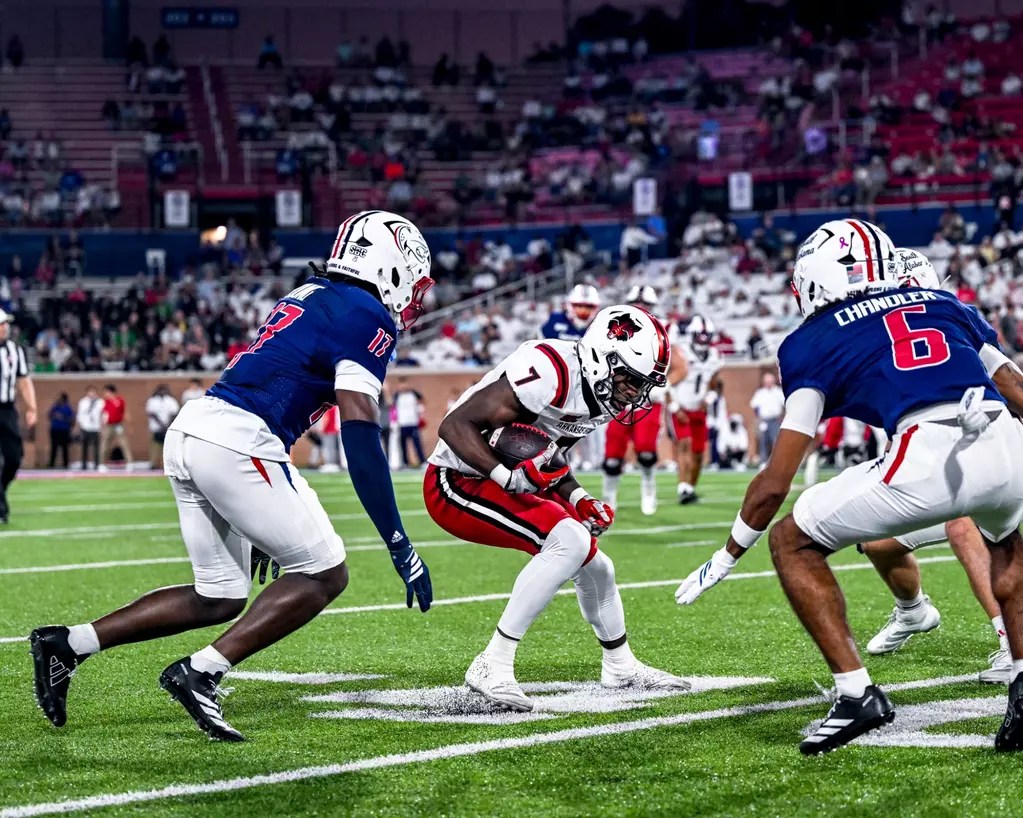
Believe it or not, there were encouraging signs on display Tuesday night. For example, we saw a few wildcat calls and reverses, which have rarely been deployed in the Butch Jones era. Also, we saw Heckendorf stick with the QB run, which had been stymied by the Jaguars defense all night, but became instrumental to Arkansas State’s 12-point fourth quarter. Heckendorf knows that Raynor’s legs are a huge asset. He’s harder to bring down in year’s past, and the threat of his arm opens lanes.
Furthermore, much of the offensive woes last night can be attributed to flags levied towards the Red Wolves’ offensive line. False starts, some called on third and short, routinely pushed the Red Wolves into bad situations. Several of those flags were thrown at center Mason Meyers, just recently returned from injury – rust was expected. But the only reason the Red Wolves were able to overcome 91 yards worth of penalties was because the Jaguars committed 130 yards of infractions.
Despite the offensive struggles, the Red Wolves triumphantly jogged out of Mobile with a victory. The defense held uber-running back Kentrel Bullock to just 72 yards – four fewer yards than Jaylen Raynor. Overall, the Jags were unable to eclipse 300 total yards, and dangerous quarterback Bishop Davenport was held to just 118 passing yards and was sacked twice. Chalk up the victory to the defense, a unit that looked hopeless against Arkansas and Kennesaw State, but has somehow become the team’s strength despite losses at linebacker.
Let’s be real! The Red Wolves have won two consecutive games by one point thanks to very-makable missed kicks. Both victories have required sudden bursts of fourth quarter offense after three quarters of missed opportunities and frustrating third down failures. Can this strategy work for the remainder of the season – perhaps we could win the next five games by a margin of five points total! Wins are wins. I’m just going to need more Tums to get me through December.
PHOTO CREDIT: A-State Athletics
 Howlraiser