
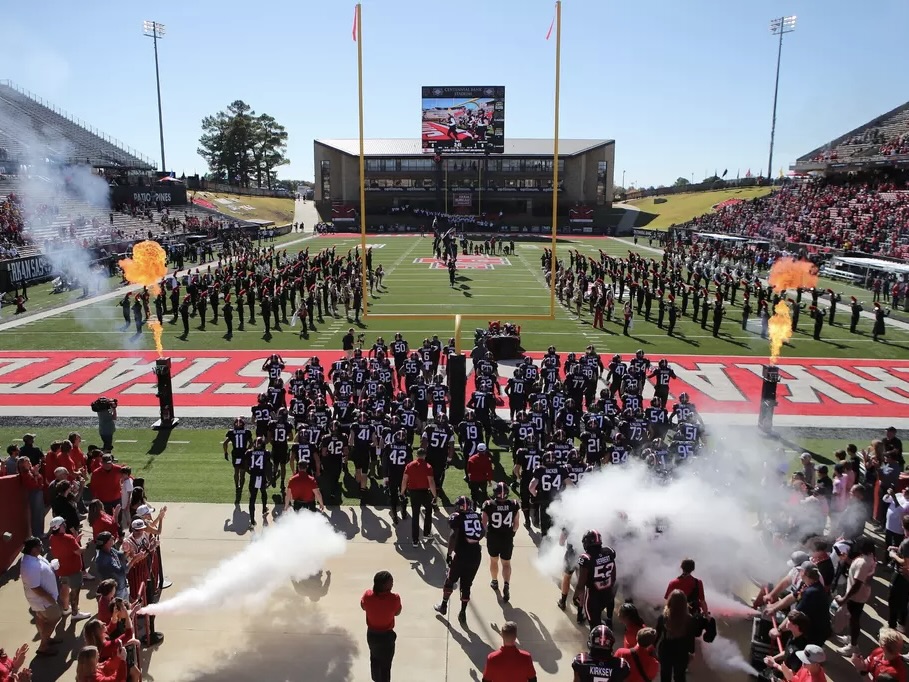
Sometimes, you cannot make it to a football game. Full transparency, when the Red Wolves hosted ranked Iowa State at Centennial Bank Stadium in Week 3, I was not in attendance. I had made a prior obligation. Worst yet, the prior obligation would see me on the campus of the University of Mississippi, where my son is a freshman. Worst of all, Ole Miss was hosting Arkansas that afternoon, so instead of supporting the Red Wolves in their most visible game of the decade, I was sharing real estate with a rival in-state program that had just destroyed my Red Wolves the week before.
Sometimes, you just cannot make it to a football game, and the reasons for it can be multiple. Ticket prices, parking fees, travel distance, hotel rates, the sheer amount of time a football game asks that you sacrifice – it takes a toll. You pick your battles. If you are a regular fan, and you miss a game, somebody is liable to arch a brow, bow up, and ask “why weren’t you there?”
Fact is, physical attendance is no longer a real measure of a program’s success. This isn’t 1995. The game has changed, and the technology for which to view it has changed. I watched the Red Wolves/Iowa State game from a tent in The Grove. I didn’t miss the game; I just wasn’t there.
After the Arkansas State/Southern Miss game, there was some vibrant discussion among a wide spectrum of people regarding the game’s attendance (officially 15,441 souls). The Red Wolves had done their part to sell tickets, lowering prices and enlisting coaches from across the A-State campus to post videos beseeching fans to make the trip. The weather was perfect – sunny and 73º with a light November breeze. The stakes were high, with the Red Wolves playing for a share of the divisional lead. There was plenty of reasons to attend.
But there are always reasons not to attend. Eleven in the morning is a weird time for football fans who hadn’t hosted a football game played before noon in Jonesboro since 1979. Some have pointed to hunting season, the enemy for all football programs in select Southern states. There are distractions, some far more appealing than sitting three or four hours in one place, enduring endless TV timeouts, massive bathroom lines and expensive beer.
It was a big game, and the university wanted a big crown. Hadn’t the university finally provided what fans demand: the opportunity to win a championship? A win on Saturday would have placed Arkansas State was this rare position for the first time 2016. What more could a fan want? But when Butch Jones marched his team onto the field, he is reported to have bemoaned what he saw in the stands, and he instructed his team to “create their own energy.”
As a Red Wolves fan, I’m not sure how I feel about that. Fans are taken for granted and take advantage of. We’re expected to fill our closets with branded merchandise and empty our bank accounts for season tickets. Today, fans are expected to fund the program’s NIL when the people profiting most from college football programs (broadcasters and retailers) are left off the hook. We’re judged if we don’t cheer loud enough. We’re criticized for rowdy behavior; we criticized for docile behavior. Absolute loyalty is demanded of us, but for God’s sake don’t criticize the coach, the administration, or the team’s performance. The team commands every dollar and every minute of of our time, but it’s our fault when crowd doesn’t infuse the proper level of energy to the team.
Since the revitalization of Red Wolves football in 2011, the entire landscape of college football has changed, and it has changed radically. When a young Huge Freeze helmed Arkansas State, the transfer portal was tiny and limited. There was no NIL. A 55-inch flatscreen TV could cost you as much as $5,000. There was no ESPN+. (In fact, a total of six Sun Belt games was broadcast on ESPN Plus’ predecessor, ESPN3). We were still three years from a college football playoff. If you wanted to see the Red Wolves play, you had to go to the games.
You can make the argument that affordable flatscreen TVs and insanely easy streaming access to games have had a significant effect on game attendance. Why fight traffic, weather and crowds when you can enjoy a comfortable game experience drinking inexpensive beer and as many snacks as you want from the comfort of your own sofa?
I have no idea what’s killing attendance at Arkansas State. I can only speculate. In many ways, we were spoiled by the successes from 2011 to 2016. We got high on championships and bowl games. We felt like Arkansas State was part of a larger conversation – that we had become fully naturalized citizens of the nationwide community that is big time college football. While it wasn’t likely that the Red Wolves would become a College Football Playoffs team, it at least felt possible. It was fun to participate; it was important to be seen participating.
Some have pointed to the team’s coaching staff and have made whatever gripes they have with roster building and play-calling an excuse to stay home. That’s a fan’s right, and honestly a fan’s only vote in the football process is directly attached to whether or not he or she buys a ticket. Let’s be honest, Butch Jones football is rarely aesthetically pleasing. Frankly it’s more stressful than fun to win (or lose) by a single score. If you wanted to sit three hours to witness a battle of field position, you may as well attend a chess tournament.
If you’re not going to at least entertain, you had better win, and that’s where some of the blame can be placed on Butch Jones, too. Losing so badly to Arkansas, when the program had five years to prepare, did not endear fans to Jones, not did falling to ULM and Kennesaw State, the latter of which Coach Jones attempts to position as a quality loss. Fans don’t recognize quality losses. Furthermore, fans aren’t moved by coaches who bemoan attendance or lecture fans about the quality of their support. It’s a losing proposition.
It does no good to use attendance as a weapon, whether hurled by coach-to-fans or fans-to-fans. Besides, when it comes to the Group of Six, it’s not the low quality of a program or the high quality of the broadcast that is sapping attendance. What is affecting attendance is the active effort to reduce G6 relevance. The first College Football Playoff Poll of 2025 didn’t feature a single G6 program. We are officially no longer part of the conversation. ESPN and Fox Sports have rapidly carved up the market to a far more digestible selection of teams, forcing the rest of us into a caste system station from which we are not allowed to elevate.
Arkansas State fans (and fans of roughly 60 more programs across the nation) are no longer invited to the table, so why even take a seat at the stadium? Fans are told that the team cannot compete without our loyalty, attendance and especially without our donations to the NIL, but the feeling of futility just increases. It’s not the Red Wolves fans are abandoning. It’s a greedy, selfish, and elitist system that actively robs us of our best players without any compensation. Whatever soul that existed in college football in 2011 has since been lost in the fine print of an ESPN broadcast contract.
I’m not about to blame anyone for not attending a football game. Heck, I missed the biggest game of the year. I do appreciate Butch Jones’ frustration with attendance, especially with a student body that he has yet to inspire, but you cannot guilt fans into coming. You can’t lower ticket prices enough. You cannot install enough seat backs or further improve stadium wi-fi. A million videos from the volleyball coach won’t convince a family in Beebe to spend the day in Jonesboro. Nagging each other about attendance won’t inflate the numbers. We’re just making ourselves feel worse while playing into the hands of the enormous entities who would love to see us tear ourselves apart
The game is on TV. The game isn’t even the same game anymore.
PHOTO CREDIT: Justin Manning, A-State Athletics
 Howlraiser